


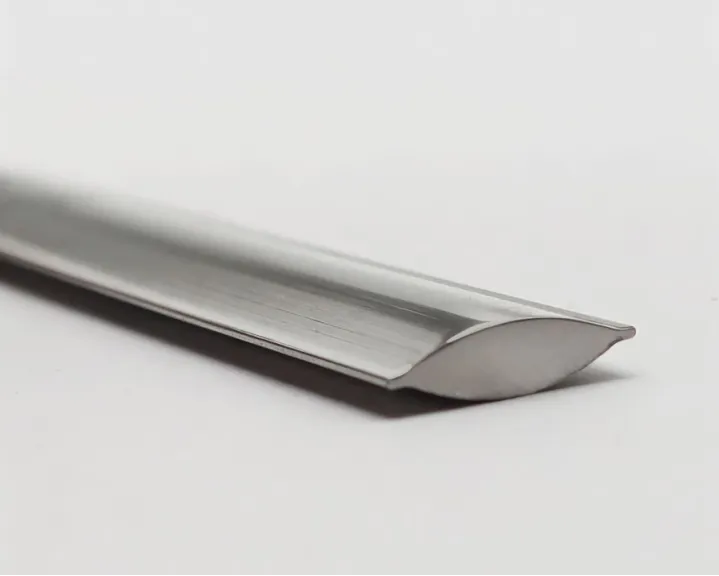
OEM metal components often need extra work before assembly. OEM metal component manufacturers often rely on secondary operations such as flattening round wire, edge conditioning, surface grinding, polishing, dimensional inspection, and rework before final assembly.
Every step takes more machining time. It wastes metal and adds burr-control work. Sizes also shift between batches. Custom stainless steel oval wire solves this. It offers a near-net-shape profile. The required cross-section is achieved before downstream cutting, forming, welding, or assembly, reducing dependence on secondary machining.
What Is Stainless Steel Oval Profile Wire?
Stainless steel oval profile wire is a precision shaped wire with an elongated oval cross-section, defined by the major axis, minor axis, controlled edge radius, and continuous curved surfaces.It features a long cross-section with a major axis and a minor axis.
It also has a set edge radius and smooth curved sides. Oval wire gives a wider touch area than standard round wire. It also sits lower in the exact same space. Unlike flat wire, it keeps its round edges. The controlled radiused edges reduce sharp-edge risk, improve visible edge appearance, and support more stable downstream forming.
Many OEM parts use this profile, like jewelry links, bag hardware, and lighting frames. It can also be used for decorative rings, clips, and precision metal components. Oval wire keeps shapes very steady and cuts down on extra machining.
How Oval Wire Reduces Secondary Machining Cost
The cost advantage is not limited to shorter cutting time. It also comes from lower stock removal, fewer deburring operations, less surface rework, reduced rejection rate, and more stable profile geometry across production batches. When a component requires the same two-dimensional section in large quantity, custom oval wire allows the material to enter production closer to the functional design.
Instead of machining round or square stock into an oval section, the required geometry is created during wire profiling. This approach is especially useful for high-volume decorative or functional metal parts where minor dimensional deviation, inconsistent edge condition, or visible surface defects may increase assembly risk and inspection cost.
Manufacturing Process: From Wire Rod to Precision Oval Profile
Production starts with selected stainless steel wire rod. Cold drawing reduces the initial diameter, improves surface condition, and prepares the material for profile forming. Intermediate annealing relieves work-hardening stress and restores ductility before shaped rolling.
During shaped rolling, the wire passes through dedicated profile tooling to form the oval cross-section. This stage controls the major-axis dimension, minor-axis dimension, edge radius, profile symmetry, and surface continuity. When the stainless steel grade, reduction ratio, or final mechanical requirement demands additional stress relief, a second annealing process can be applied.
Final fine drawing improves dimensional consistency, tensile properties, and surface smoothness before coiling, spooling, inspection, and packaging. We offer a range of surface finishes, including polished, bright, and mirror-polished, along with protective treatments such as passivation and wax coating, allcustomizable to your specific requirements for appearance, corrosion resistance,downstream processing, and packaging.
Key Specifications for Custom Oval Wire RFQs
To get a good price, your RFQ needs clear details. Please share the drawing, stainless steel grade, major-axis dimension, minor-axis dimension, and tolerance range. We also need your edge-radius requirement, tensile strength or hardness, and surface condition.
Tell us your coil or spool requirement, packaging method, trial quantity, and annual demand. For visible parts, please set the acceptable surface defect level and inspection standard.
Quality Control for Precision Shaped Wire
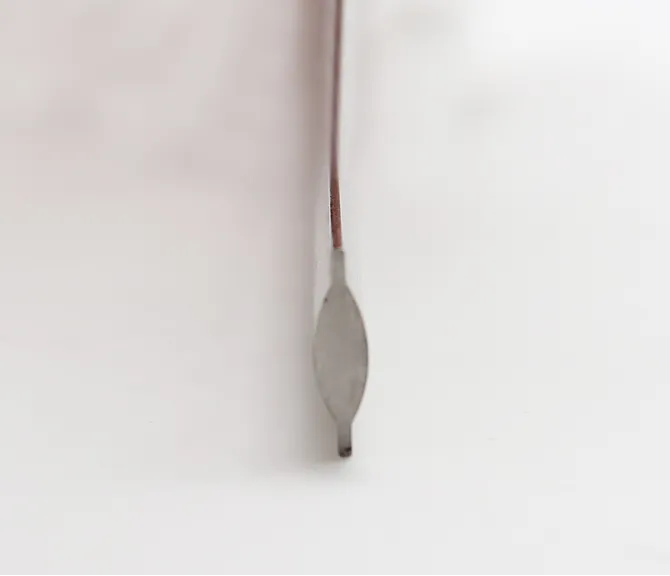
Precision shaped wire requires more than basic diameter measurement. For oval profile wire, quality control should verify alloy grade, dimensional stability, tensile performance, cross-section consistency, surface finish, and coil condition.
Spectrometer analysis supports material verification. Tensile testing confirms mechanical performance. 1D/2D projectors and dimensional inspection equipment help check the major axis, minor axis, profile symmetry, edge radius, and tolerance consistency.
Jingzhou’s Custom Profile Wire Manufacturing Capability
At Jingzhou, we integrate profile-wire design, tooling development, controlled forming, fine drawing, batch production, and dimensional inspection within one stainless steel wire manufacturing system. Since 2009, we have focused on stainless steel shaped wire and round wire production, supported by three production bases, more than 80 production lines, and an annual capacity of 18,000 tons.
This integrated capability allows us to supply stainless steel oval wire as a repeatable near-net-shape solution for OEM applications. Instead of offering only standard wire forms, we help customers convert machining-intensive components into profile-controlled wire products with stable cross-sections, consistent surfaces, and scalable batch delivery.
We produce oval wire in stainless steel grades such as 304, 304L, 316, 316L, 316Ti, 321, 430, 310S, and project-specific alloys according to application requirements.
FAQ
Q1: What is the main advantage of custom stainless steel oval wire?
A: It reduces flattening, edge conditioning, grinding, polishing, and dimensional rework by providing a near-net-shape cross-section.
Q2: Which specifications are needed for custom oval wire production?
A: The main information includes the drawing, material grade, major and minor dimensions, tolerance, edge radius, mechanical requirement, surface condition, packaging method, and order volume.
Q3: Which surface conditions are available?
A: We can supply polished, bright, passivated, waxed, and mirror-polished surfaces according to the application and downstream processing method.