


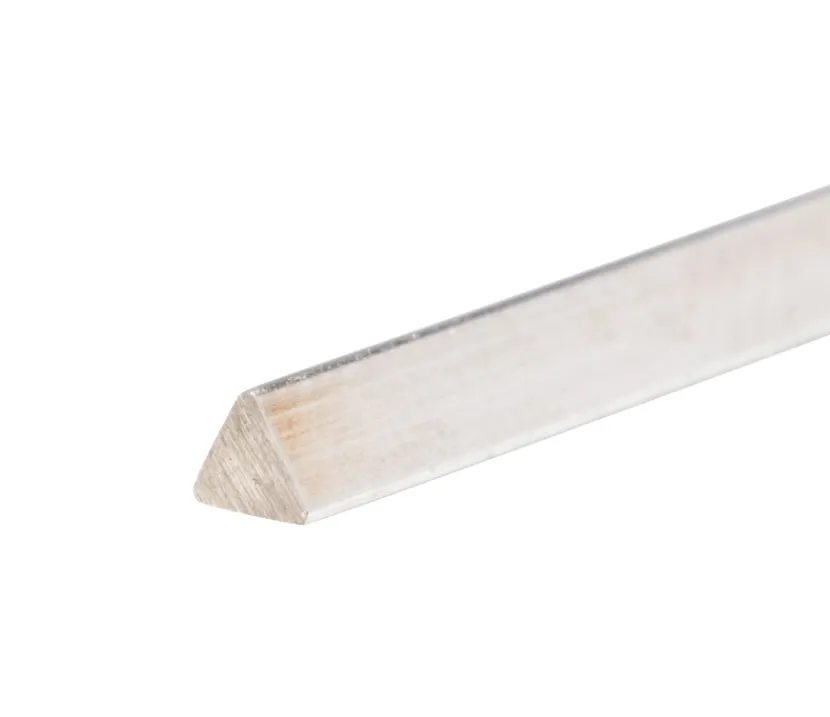
Clogging is not a small issue in industrial filter screens. Once particles lodge inside the slot, flow drops, differential pressure rises, and cleaning takes more time than planned. V-shaped wire solves this problem from the screen structure itself. Its wedge-shaped profile forms a precise slot opening on the filtration surface, while the inner passage becomes wider, so retained solids stay on the surface instead of jamming deep inside the screen.
What Is V-Shaped Wire in Industrial Filter Screens?
V-shaped wire, also known as wedge wire or triangle wire, is a type of stainless steel profile wire characterized by a triangular cross-section. Its unique geometry enables precise filtration, self-cleaning, and high structural strength in screening and separation applications. In a wedge wire screen, the working wire is welded to support rods. The space between each profile forms a continuous slot design, which gives the screen high open area and stable liquid throughput.
This structure is widely used in water treatment, oil and gas, mining and mineral processing, food and beverage processing, and pulp and paper. You may see it as water well screens, dewatering panels, vibrating screen panels, centrifuge baskets, resin traps, intake screens, and pulp screening cylinders.
Jingzhou Metal has produced stainless steel wire since 2009, with three production bases covering 18,000 square meters, more than 80 production lines, and an annual capacity of 18,000 tons. For buyers comparing factories, its value is not only scale. The stronger point is the link between stainless steel shaped wire, profile control, tensile testing, and customized screen production.
How Does Tapered Slot Geometry Reduce Clogging?
The key is tapered slot geometry. Oversized particles are stopped on the screen surface. Finer particles pass through the widening slot with less flow resistance. Compared with woven mesh or perforated plate, a non-blinding slot gives fewer trapped particles and easier backwashing.
Slot size can be made according to the retained particle range. Common project requirements may include 0.05 mm, 0.10 mm, 0.25 mm, 0.50 mm, or larger openings. The correct slot tolerance matters. A local narrow point can collect fibers or sand, while an oversized slot may let solids pass.
Which Materials And Processes Matter Most?
Material selection depends on the medium. 304 stainless steel suits general filtration. 316L stainless steel is often selected for chloride-containing water or chemical filtration. Duplex 2205 and 904L stainless steel are used when corrosion resistance, tensile strength, and pressure resistance need a higher margin. Jingzhou Metal also lists 202B, 304L, 316Ti, 321, 430, and 8825 for shaped wire projects.
The production route starts with wire rod selection, then cold drawing, annealing, shaped rolling, second annealing when required, and fine drawing. Fine drawing improves profile dimension control and surface finish. Surface finish means the surface condition, often linked with Ra value. Surface treatment is different. A pickled and passivated surface or electropolished surface can be selected for corrosive or sanitary service.
Quality checks should not be a formality. Spectrometer analysis verifies material composition. A tensile force meter checks mechanical performance. Infrared detection monitors dimensional variation across coils. 1D and 2D projectors check profile geometry, helping keep slot consistency before welding.
For custom wedge wire screen projects, Jingzhou Metal supports custom wire profile dimensions, opening sizes, overall dimensions, support rod shape, and drawings-based production. That is where anti-clogging performance becomes practical, not just a catalog claim.
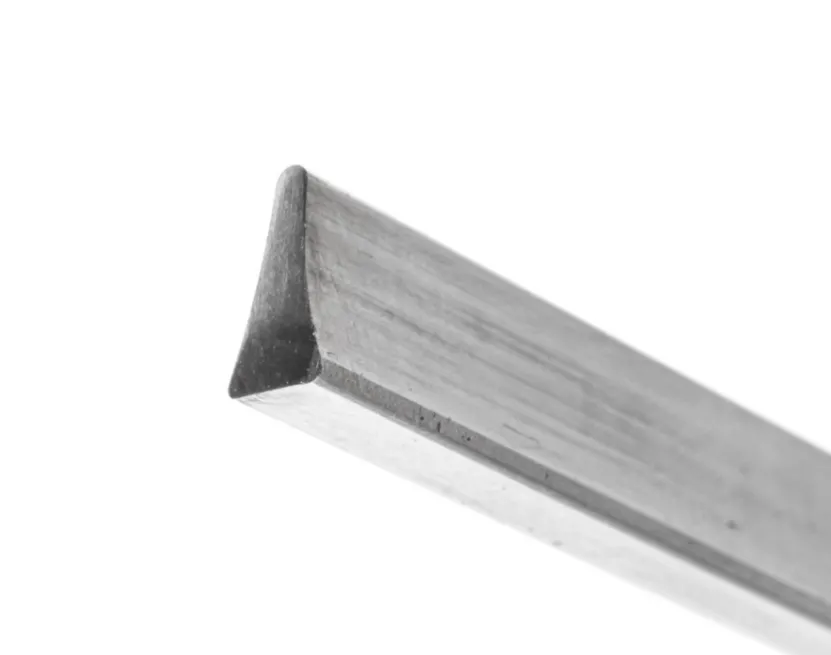
FAQ
Q1: How Do You Choose Slot Size?
A: Your slot size must fit the retained particle size and solids concentration. It also needs to support your flow rate and cleaning method. Going with a smaller slot isn’t automatically ideal. It can actually shrink your open area. Plus, this often pushes up the differential pressure.
Q2: Why Is V-Shaped Wire Better for Clogging Control?
A: The V-shaped wire profile creates a narrow surface slot and a wider inner passage. Particles are less likely to wedge inside the screen.
Q3: What Is the Difference Between Surface Finish And Surface Treatment?
A: Surface finish refers to surface condition or Ra value. Surface treatment refers to processes such as pickle and passivate or electropolish.
Q4: Which Stainless Steel Grade Should You Select?
A: 304 fits basic filtration. 316L handles chloride media better. For tough chemicals, high pressure, or heavy wear, check Duplex 2205 or 904L.
Q5: What Information Is Needed for a Custom Screen?
A: Share the material grade, slot opening, and slot tolerance. Tell us your screen type, diameter, or panel size. Note the support rod size and filtration direction. Lastly, include your working medium, temperature, pressure, and any drawings.