


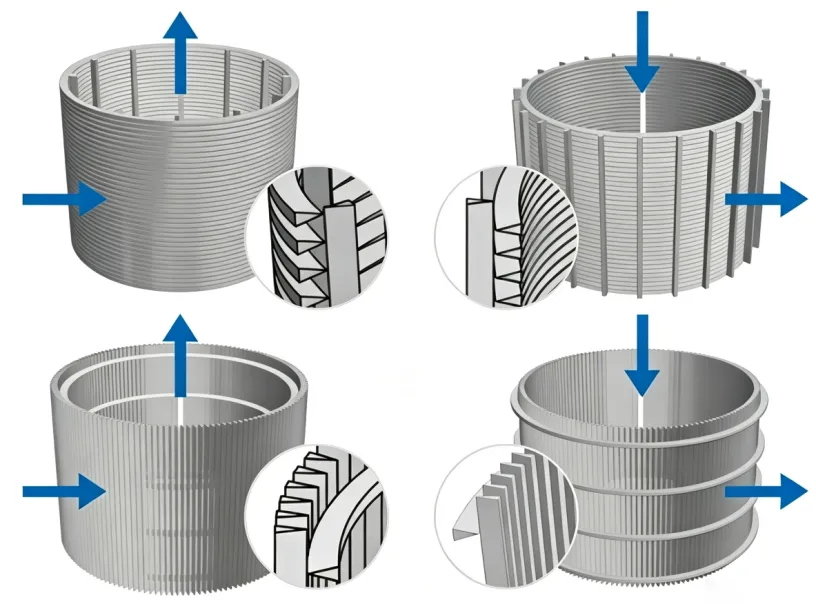
A wedge wire screen cannot be selected from slot size alone. A reliable specification combines particle retention, hydraulic capacity, mechanical loading, corrosion exposure, flow direction, cleaning method, and fabrication geometry. We use these inputs to match the surface-wire profile, support arrangement, material grade, and finished screen configuration to the operating duty.
Screen Structure and Filtration Principle
A wedge wire screen uses parallel V-shaped surface wires. They are resistance-welded to support rods at every joint. The slot sits tightest at the process face. It gets wider toward the downstream side. This setup halts particle wedging. It maintains steady flow. Retained solids drop off easier during scraping or backwashing.
Flat panels, cylinders, baskets, curved screens, and filter nozzles share this core build. Specs identify flow-out-to-in (FOTI) or flow-in-to-out (FITO). Wire layout directly shifts solids retention, scraper position, and overall cleaning success.
Slot Opening, Profile, and Support Design
Slot selection starts with the particle-size distribution. You must catch the smallest fraction. Particle shape and compressibility matter too. Mesh count alone cannot define fibers, soft solids, and irregular mineral particles.
A full drawing details the nominal slot opening and tolerance. It shows the surface-wire section, support-rod section, and pitch. It includes flow direction, overall dimensions, and frame or end-fitting requirements. Nominal open area is calculated as:
Open area (%) = slot width / (slot width + surface-wire width) x 100
This value excludes the area blocked by support rods, frames, weld zones, and end fittings; effective open area is therefore lower.
We roll standard and custom V-shaped profiles from 0.5 x 1.0 mm to 5.0 x 10.0 mm, with profile dimensional tolerance down to +/-0.01 mm, subject to the approved drawing and inspection plan. Available screen slots range from 0.02 mm to 5 mm, with standard widths up to 1,200 mm and lengths up to 6 m. Profile tolerance and welded slot tolerance are separate acceptance criteria.
Preliminary Application Reference
| Application | Typical slot | Preliminary material candidates |
| Water and wastewater treatment | 0.20-1.00 mm | 304L or 316L |
| Oil and gas filtration | 0.10-1.00 mm | 316L, 2205, or 2507 |
| Mining and mineral screening | 0.50-5.00 mm | 304, 316, or 2205 |
| Food and beverage filtration | 0.10-1.00 mm | 304L or 316L |
| Pulp and paper screening | 0.15-1.00 mm | 316L or 2205 |
These ranges are RFQ starting points, not final design limits.
Stainless Steel Grade Selection
304L is commonly considered for general low-chloride service and welded assemblies; its lower carbon content reduces sensitization risk during welding. 316L provides improved resistance to localized corrosion but is not a universal seawater grade. For higher chloride exposure, 2205 duplex stainless steel offers greater strength and better resistance to chloride-induced stress corrosion cracking. 2507 super duplex may be evaluated for more severe chloride service.
The grade review covers operating temperature, chloride concentration, pH, dissolved oxygen, crevices, cleaning chemicals, welding condition, and required service life. We verify alloy chemistry by spectrometric analysis and maintain material identification throughout production.
Profile-Wire Production and Screen Fabrication
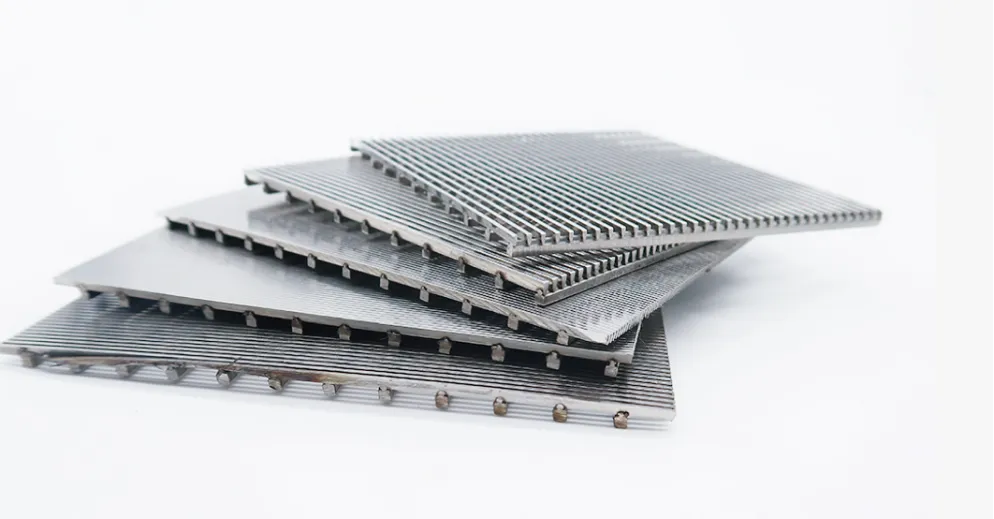
Profile-wire production includes wire-rod preparation, cold drawing, intermediate annealing, profile rolling, secondary annealing, final drawing or calibration, inspection, and packaging. Screen fabrication is a separate process: surface wires are resistance-welded to support rods, then cut, rolled, seam-welded, framed, or fitted with end components as required. Slot consistency, flatness or roundness, weld integrity, and final dimensions are checked against the approved drawing.
Surface condition and surface treatment are separate specifications. Final drawing establishes the as-drawn surface. When specified, we polish the filtering face to modify surface texture, pickle fabricated parts to remove heat tint or scale, and passivate cleaned stainless steel to support restoration of its passive film. A polished screen is not necessarily a passivated screen.
Manufacturing Control at Jingzhou Metal
We have produced stainless steel wire since 2009 and operate three production bases covering approximately 18,000 square meters. In-house tool development and CNC grinding allow us to adjust profile width, height, nose radius, and corner radius to the customer’s screen design. One-dimensional and two-dimensional optical projectors verify geometry; in-process infrared dimensional monitoring and manual checks track coil consistency; tensile testing verifies mechanical properties. After technical confirmation, the typical new-profile development cycle is 7-15 days.
FAQ
What is the difference between nominal and effective open area?
Nominal open area is calculated from slot and surface-wire width. Effective open area also accounts for support rods, frames, weld zones, and blocked edge areas.
When is FITO construction appropriate?
FITO is considered when solids collect inside a cylinder, an internal scraper removes the cake, or backwashing discharges outward. The equipment layout and pressure direction are reviewed together.
Can a worn sample be used to reproduce a custom profile?
A sample can support reverse engineering, but wear, distortion, and residual stress may alter measured dimensions. A CAD drawing confirms critical radii, tolerance, hardness, and functional surfaces before production.
How is slot consistency evaluated on a finished screen?
The inspection plan defines measurement locations across the width or circumference and along the screen length. First-article results and production inspection records are agreed before volume manufacture.