


The ideal wedge wire screen open area ratio comes from process duty. It needs flow area, a solids-retention slot, and welded strength. Published range: 15–65%. Calculate the project value from process data.
What Does a Wedge Wire Screen Do?
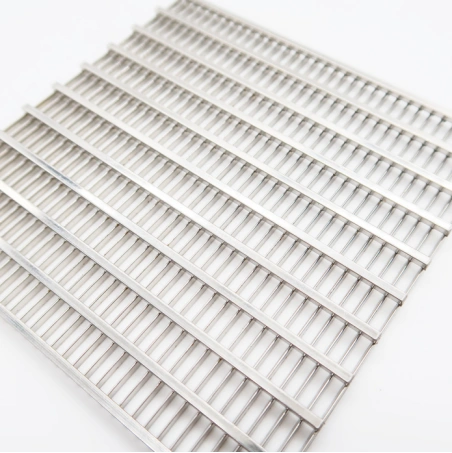
A wedge wire screen separates solids from liquids, gases, powders, and media through continuous slots. V-shaped wires sit on support rods. The profile gives an entrance and wider passage for flow and cleaning.
Where Do You Use It?
Use panels, curves, cylinders, or nozzles across water, oil and gas, mining, beverage, powder, and pulp separation.
How Do You Calculate Wedge Wire Screen Open Area?
The wedge wire screen open area calculation uses the repeated surface pattern. Frame area, end rings, welds, and fouling need separate review. The wedge wire screen open area formula is:
Open Area (%) = Slot Width / (Slot Width + Wire Width) × 100
Slot width and wire width define the pattern. A 0.50 mm slot with 1.50 mm wire gives 25%. With 1.00 mm wire, it gives 33.3%.
Practical Calculation Table
| Slot Width (mm) | Wire Width (mm) | Open Area |
| 0.50 | 1.50 | 25.0% |
| 0.50 | 1.00 | 33.3% |
| 1.00 | 1.50 | 40.0% |
The V-wire screen open area supports flow sizing. Capacity also depends on viscosity, solids loading, area, velocity, flow direction, and fouling. The ratio alone does not set separation.
Which Factors Set the Ideal Open Area Ratio?
Your target links retained size, hydraulics, loading, and service environment. This keeps wedge wire screen slot size tied to the process.
Slot and Wire Geometry
The supplied screen range covers slots from 0.02 to 5 mm. Jingzhou Metal lists raw profiles from 0.5 × 1.0 mm to 5.0 × 10.0 mm, with ±0.01 mm tolerance. A narrower surface wire raises calculated open area. A wider profile adds strength and wear material. Your drawing should state profile, face width, height, tolerance, and measurement method.
Flow, Load, and Material
Flow rate and allowable pressure drop set active area. Differential pressure, span, support-rod pitch, and abrasion set the structural review. Chemistry, temperature, sanitation, and cleaning guide materials. Available grades include 304, 316, 316L, 321, duplex stainless steel, and nickel alloys.
| Parameter | Jingzhou Metal Stated Range | Why It Matters |
| Slot Opening | 0.02–5 mm | Sets retained size. |
| Screen Length | Up to 6,000 mm | Sets layout. |
| Screen Width | 25–1,200 mm | Sets active area. |
| Surface Wire Options | 1.50–3.70 mm listed sizes | Sets geometry. |
How Do Applications Change the Selection?
The same percentage behaves differently in water, abrasive slurry, or fibrous pulp.
Water, Mining, Oil, and Food Duties
For wedge wire screen for water treatment, review flow, media retention, backwash, chemistry, and layout. Water well screen open area needs formation sand data and pressure. A mining wedge wire screen needs feed size, tonnage, and abrasion. Sieve bend screen open area depends on feed solids and angle.
A wedge wire sand control screen needs formation and corrosion data. Wedge wire screen for food and beverage needs sanitation, viscosity, finish, and cleaning. Pulp screening wedge wire needs fiber size, solids, and cleaning access.
How Can a Technical Partner Verify the Design?
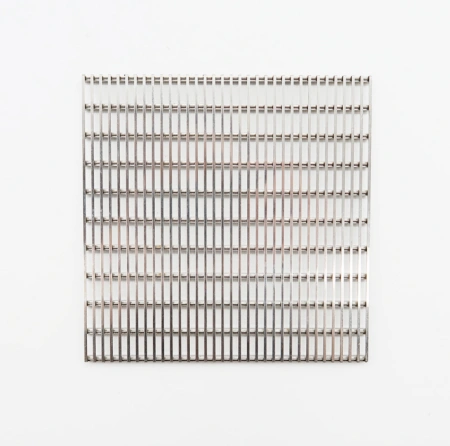
An accurate specification connects the calculation to measured wire and screen data. Jingzhou Metal develops shaped wire from CAD drawings and supports custom wedge wire screen specifications for panels, curves, cylinders, and nozzles. As a wedge wire screen manufacturer, it states a 7–15 day shaped-wire development cycle.
What Should the Quality Review Include?
The sequence includes wire rod, cold drawing, annealing, shaped rolling, second annealing, fine drawing, packaging, and delivery. Checks cover dimensions, projection, infrared monitoring, and tensile testing. The procedure checks incoming wire, die threading, straightness, twist, and finished dimensions. It records 80–100 cm samples with a 30-degree twist limit and checks appearance hourly.
For a wedge wire screen RFQ, send slot tolerance, wire profile, support-rod layout, dimensions, flow, pressure, medium, solids data, material, cleaning method, certificates, and quantity. A wedge wire screen supplier can review the wedge wire screen open area ratio. The stainless steel wedge wire screen product page lists screen forms and applications.
FAQ
Q1: Optimal open area ratio for Wedge Wire Screens?
A: Pick a ratio balancing flow and pressure drop. It must also handle separation, strength, and cleaning. A 15%-65% range offers a reliable baseline.
Q2: How to calculate Wedge Wire Screen open area?
A: Add slot width and wire width. Divide slot width by this total. Multiply by 100. A 0.50 mm slot with 1.50 mm wire yields 25%.
Q3: Does a larger slot always improve screen performance?
A: It boosts geometric open area if wire width stays fixed. Yet, it must still reliably catch target particles.
Q4: Which material fits a stainless steel Wedge Wire Screen?
A: Choose 304, 316, 316L, 321, duplex stainless steel, or nickel alloy. Base decisions on specific chemistry, temperature, pressure, and sanitation facts.
Q5: What Data Should You Include in a Wedge Wire Screen RFQ?
A: Include slot, tolerance, profile, dimensions, flow, pressure, medium, solids, material, support layout, cleaning, inspection records, and quantity.