


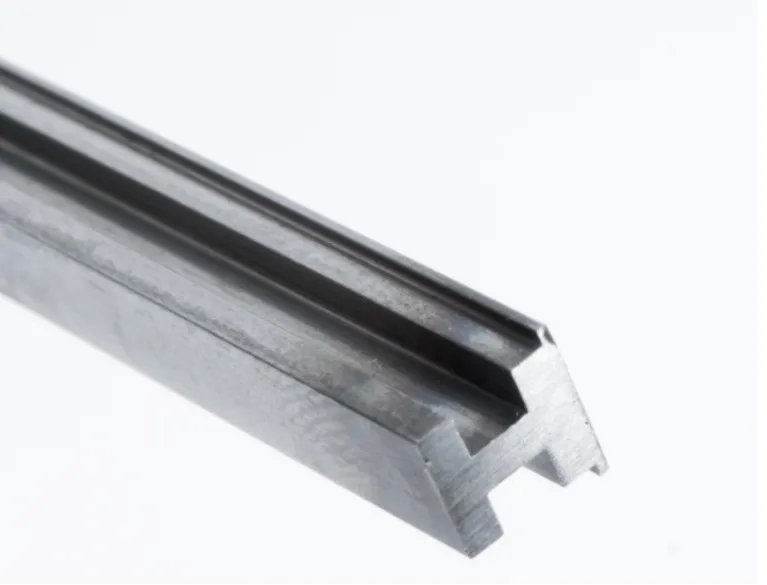
Minor guide discrepancies in conveyor systems frequently escalate into significant operational disruptions. A worn rail edge, poor guide clearance, or uneven surface finish can cause conveyor misalignment, belt drift, product displacement, noise, and unplanned maintenance downtime. H-shaped wire for conveyor systems is used as a precision guide rail profile when moving parts need stable lateral guidance and repeatable contact geometry.
What Does H-Shaped Wire Do in Conveyor Systems?
Unlike standard drive belts, pulleys, or bearings, a conveyor guide rail wire functions as a specialized formed profile engineered to guide, support, and align moving components. In operating conveyor lines, especially in packaging lines and transfer conveyor modules, the recurring issue is often lateral movement after thousands of repeated operating cycles, not speed alone.
Structure and Application
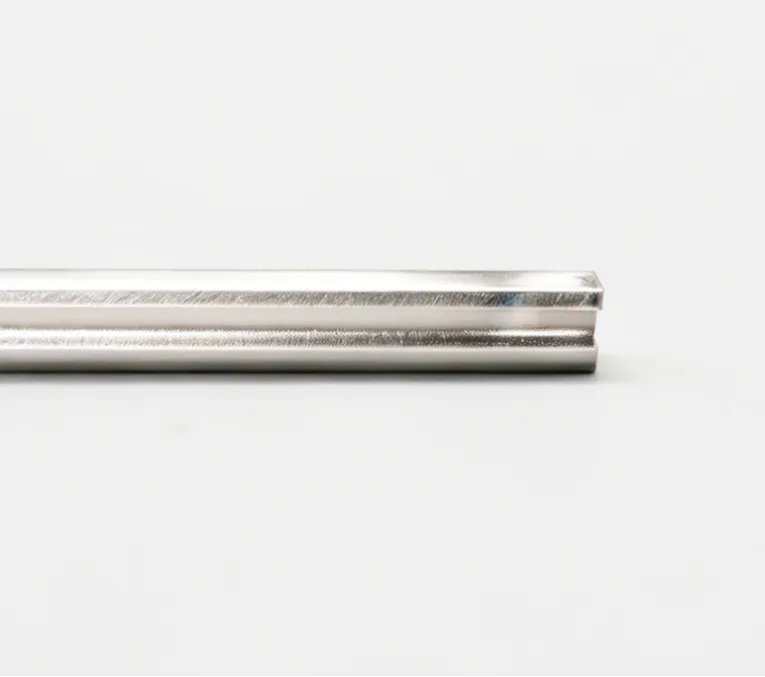
H-shaped guide rail wire has an H-shaped cross-section with parallel contact lands and a central web. This balanced profile gives the mating groove or guide channel more locating surfaces than round wire. It can work as conveyor side guide rails, a conveyor guide rail insert, a sliding contact rail, or a wear-resistant support profile.
In pulley-guided conveyor modules, ball bearings reduce friction through rolling contact, while the guide rail controls the running path. These components address distinct mechanical requirements.Accurate rail geometry helps reduce localized contact stress, uneven guide rail wear, and lateral deviation.
Which Specifications Matter Most?
For conveyor OEMs and maintenance teams, an effective drawing usually includes more than the outside size, such as profile width, profile height, central web thickness, contact land width, edge radius, corner radius, groove width, groove depth, and guide clearance.A minor dimensional deviation may appear negligible during initial assembly, yet manifest as elevated operational noise after consecutive shifts.
Material, Size, and Groove Fit
Jingzhou lists H-shaped wire sizes from 0.5 × 1.0 mm to 5 × 10 mm, with dimensional tolerance up to ±0.01 mm. Material choices include carbon steel H-shaped wire for strength and cost control, 304 stainless steel H-shaped wire for general corrosion resistance, and 316 stainless steel H-shaped wire for wet or chloride-containing environments.
Surface finish and surface treatment are usually specified as separate items.Surface finish refers to measured surface roughness, such as Ra or Rz. Surface treatment refers to processes: polish the wire, passivate stainless steel, pickle stainless steel, or coat carbon steel. A polished H-shaped guide rail wire may lower abrasion, but a passivated stainless steel profile wire mainly improves corrosion resistance.
How Does Manufacturing Affect Maintenance Downtime?
Custom profile wire quality depends on how consistently the section is formed across the full coil. A single approved sample does not always confirm coil-to-coil stability, especially when guide clearance is sensitive.At this stage, production control directly affects guide clearance stability, rail wear, and repeat assembly quality.
Process and Inspection
Jingzhou has focused on stainless steel wire since 2009, with three production bases covering about 18,000 square meters. Its work in profiled wires, including stainless steel, copper, and titanium profiles, fits conveyor projects that need drawing-based profile wire customization rather than catalog-only parts.
The typical process includes wire rod selection, cold drawing, round wire annealing, shaped rolling, intermediate annealing, fine drawing, final sizing, and packaging. For quality control, spectrometer analysis checks alloy grade, tensile strength testing verifies mechanical performance, infrared dimensional monitoring tracks coil variation, and 1D and 2D projector inspection checks profile dimensions. These checks help custom H-shaped wire according to OEM drawings reduce premature rail replacement and batch-to-batch assembly issues.
FAQ
Q1: Is H-shaped wire used as a conveyor belt?
A: No. H-shaped wire is used as a conveyor guide rail wire or support profile. It guides and aligns moving conveyor components.
Q2: Which Material Grade Is More Suitable for Conveyor Guide Rails?
A: Carbon steel is optimal for dry, cost-sensitive operations. 304 stainless steel is engineered for general industrial applications, whereas 316 stainless steel is highly recommended for moisture-rich or corrosive chemical environments.
Q3: Can H-shaped wire reduce sliding friction in conveyor systems?
A: Yes, when profile tolerance, surface roughness, edge radius, and guide clearance are correctly specified. It does not replace bearings.
Q4: What Data Is Usually Included in an OEM Drawing?
A: An OEM drawing usually includes profile width, profile height, web thickness, contact land width, corner radius, edge radius, groove width, groove depth, material grade, and tolerance.
Q5: Can Jingzhou make custom stainless steel profile wire?
A: Yes. Custom stainless steel profile wire can be produced according to specific dimensions, profile drawings, and application requirements.