


Why Do Filtration Equipment Manufacturers Specify Profile Wire?
Filtration equipment manufacturers use profile wire when a screen must hold a defined slot, carry pressure, and release solids during cleaning.
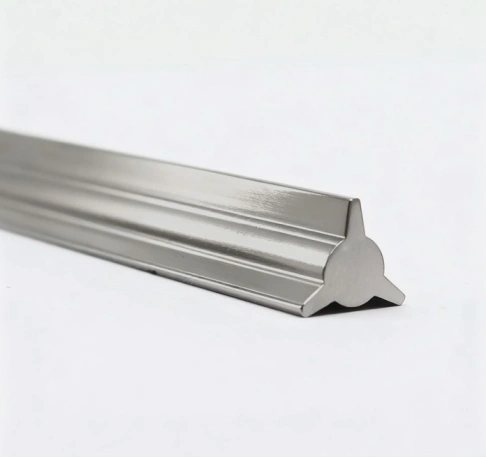
A wedge or triangle wire has a V-shaped cross-section. The narrow nose faces the process side; the wider base is welded to support rods. This geometry creates a continuous slot and a smooth, clog-resistant surface.
How Does the V-Shaped Cross-Section Work?
Fluid enters through the nose slot. The opening widens toward the support side, reducing particle contact during backwash or vibration.
The wire also acts as a structural member. Flat screens, curved panels, tubes, and nozzle tubes use the same principle with different support layouts.
Where Is It Used?
Typical duties include intake and wastewater screens, sand filters, oil and gas sand-control screens, mining baskets, powder classifiers, brewing filters, and pulp screening. In water treatment, the slot controls media retention. In pulp lines, the profile separates fiber while the welded grid carries loads.
Which Parameters Define a Custom Stainless Steel Profile Wire?
The drawing should define cross-section, alloy, tolerance, coil condition, and inspection method. A screen drawing adds slot, support-rod pitch, panel dimensions, and weld pattern.
Profile Wire and Screen Parameter Table
| Item | Typical or available value | Design note |
| Profile types | Flat, square, T, D, half-round, oval, triangle, wedge | Select geometry from load and flow needs |
| Profile size | 0.5×1.0 to 5.0×10.0 mm | Custom sections follow a CAD drawing |
| Dimensional tolerance | ±0.01 mm for wedge wire | Confirm critical height, width, and radius separately |
| Common alloys | SS304, SS316, SS316L, SS321, 904L, 2205 | Match chloride, temperature, and chemical exposure |
| Wedge wire size in screens | 1.50, 1.80, 2.30, 3.00, 3.30, 3.70 mm | Select with support-rod size and load |
| Slot opening size | 0.02–5 mm | Set from retained particle size and flow rate |
| Screen length / width | Up to 6 m / 25–1200 mm | Larger dimensions can be made to drawing |
How Do Alloy and Surface Condition Affect Service?
SS304 suits general industrial water and food duties. SS316 and 316L add molybdenum for chloride-bearing water and chemical service; low-carbon 316L supports welded assemblies. 904L, duplex 2205, and super duplex 2507 suit aggressive corrosion conditions. Surface brightness describes appearance. Surface treatment describes drawing, polishing, or passivation; list them separately.
How Is Dimensional Consistency Controlled?
The route starts with wire rod, cold drawing, round-wire annealing, shaped rolling, a second anneal, and fine drawing. Cold drawing reduces section. Annealing relieves stress before shaped rolling forms the V, wedge, flat, or other section. Fine drawing controls final size and surface condition.
What Does the Inspection Flow Check?
Operators verify the incoming coil, die direction, and weight. After forming, a sample is checked on a flat reference surface for corner angle and linear twist; the documented limit is 30 degrees. After die adjustment, a second sample receives the same check. Production runs under a 150 tension setting, with hourly checks for damage, deformation, discoloration, fins, missing sections, and dimensions.
Which Instruments Support the Checks?
Infrared detection monitors runout across the coil. One- and two-dimensional projectors inspect height, width, and tolerance. Tensile testing records maximum stress before break.
Spectrometer analysis verifies alloy composition, while mold repair keeps the cavity within working geometry. Each batch can carry dimensional, tensile, and material records.
How Can Profile-Wire Control Support Your Screen Design?
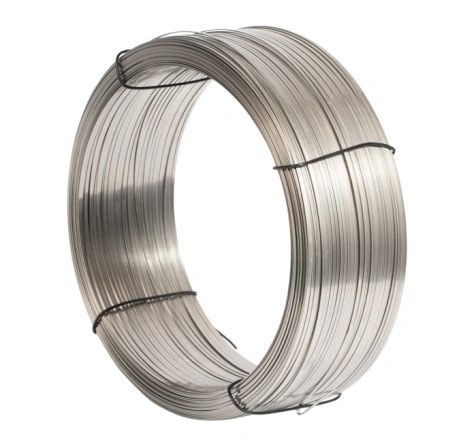
Screen performance depends on wire geometry, slot, support rod, and weld sequence. Jingzhou Metal develops profile dies for regular and irregular sections, accepts CAD specifications, and produces wedge wire, triangle wire, flat wire, and other shaped wire for filtration assemblies.
Its process combines shaped rolling, fine drawing, infrared runout monitoring, projector measurement, tensile testing, and manual inspection. This provides one technical path from sample approval to repeat coils. Product details are available through the wedge wire product page, and general contact information is listed on the company website.
FAQ
Q1: What is the difference between stainless steel profile wire and wedge wire?
A: Profile wire is the broad category covering many cross-sections. Wedge wire is a V-shaped or triangular profile used widely in welded screens.
Q2: Which slot opening size should a screen use?
A: Set the slot from the smallest particle to retain, required flow, solids loading, and cleaning method. The available range is 0.02–5 mm, subject to the wire and support design.
Q3: Is 316L suitable for welded filtration screens?
A: 316L suits chloride-bearing or chemical service and its low carbon content supports welded construction. Confirm temperature and chemical concentration before final selection.
Q4: What drawing data is needed for a custom wire quote?
A: Provide cross-section dimensions, nose and corner radii, alloy, tolerance, coil or straight length, tensile condition, surface requirement, and the intended screen weld layout.
Q5: How should incoming profile wire be accepted?
A: Check alloy certificates, coil identification, dimensions at several points, surface defects, straightness, and tensile results. Compare the records with the approved drawing before welding the screen.