

What Filtration Problems Do Mining Plants Face?
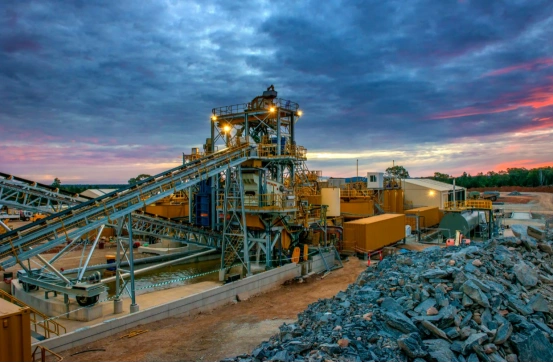
Mining circuits handle abrasive ore, clay, coal slurry, and recycled process water in the same shift. Screens must separate solids at a stable cut point while pumps, cyclones, thickeners, and centrifuges keep running.
Common industrial filtration challenges in mining operations include rapid abrasion, slot blinding, unstable feed density, corrosion from chlorides or acidic water, and screen deformation under vibration.
Abrasion, Blinding, and Corrosion in One Stream
Fine clay packs openings; angular quartz cuts wire surfaces; high-chloride water attacks weld zones. A screen that passes water at startup can lose flow after a few hours when particles bridge across the aperture.
The design therefore needs a defined slot, a load path through support rods, and a material grade matched to water chemistry.
Where Screens Sit in the Process
Mining screens appear in scalping, sizing, desliming, coal-slurry recovery, tailings treatment, and concentrate dewatering. Flat panels suit vibrating screens. Curved panels recover solids from slurry with continuous flow. Cylindrical screens and centrifuge baskets support liquid-solid separation at higher rotational loads.
How Does Wedge Wire Screen Construction Solve These Issues?
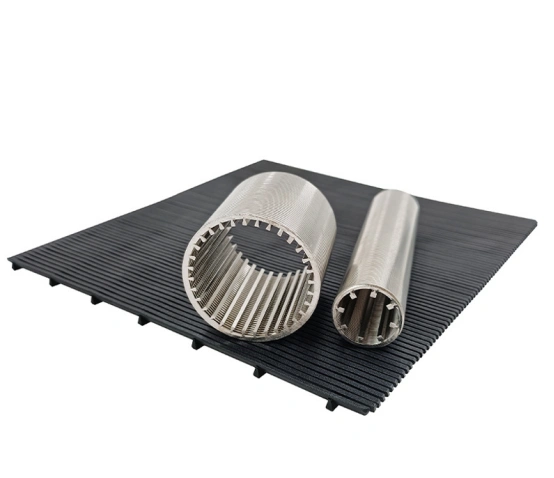
The wedge wire screen filter uses V-shaped profile wires welded to support rods. The narrow edge faces the feed, while the wider body carries load. As particles move across the surface, the slot widens toward the discharge side, reducing wedging and helping water leave the panel.
V-Profile Geometry and Open Area
The V profile creates a continuous opening along each support rod. This geometry gives a smooth screening face, predictable slot measurement, and cleaning access from the backwash side. Open area must match feed rate and panel strength; increasing slot width raises hydraulic capacity while changing the cut point.
Screen Forms for Mining Equipment
Flat screens fit vibrating decks and static sieve bends. Curved screens support coal-slurry recovery and tailings treatment. Wedge wire tubes fit rotary or pressure vessels. Nozzle tubes distribute and collect water in filtration vessels. The same profile-wire principle carries load through each support rod.
Which Parameters Should You Specify?
Start with particle-size distribution, slurry density, flow rate, pressure, temperature, and cleaning method. Then define the screen envelope and attachment details. The following ranges provide a practical design starting point.
| Parameter | Available or Reference Range | Design Note |
| Wedge/profile wire | 1.50, 1.80, 2.30, 3.00, 3.30, 3.70 mm; custom 0.5×1.0 to 5×10 mm | Larger sections carry higher mechanical load |
| Slot opening | 0.02–5 mm | Set from target cut size and blinding risk |
| Support rod | 2.30, 3.00, 3.30, 3.70 mm | Spacing controls panel stiffness |
| Screen width | 25–1,200 mm | Match deck or vessel clearance |
| Screen length | Up to 6,000 mm standard | Longer panels may need intermediate supports |
| Dimensional tolerance | ±0.01 mm for wedge wire | Verify slot and profile before welding |
| Typical grades | SS304, SS304L, SS316, SS316L | Select 316/316L for chloride-rich water |
Material and Surface Selection
SS304 covers general service. SS316 adds molybdenum for chloride exposure, while 304L and 316L support welded assemblies with lower carbon content. Surface finish describes the wire’s visual and roughness condition, such as bright, plain, or dull. Surface treatment is a separate operation, such as cleaning, passivation, or coating. Keep these terms separate in a purchase specification.
How Do You Control Quality Before Installation?
Mining screens need checks that connect wire production to field performance. A controlled route starts with wire rod, cold drawing, annealing, shaped rolling, and final annealing.
Dimensional inspection measures profile size and slot consistency. Infrared monitoring tracks runout along the coil. Operators check appearance, deformation, edge defects, and color during production, then measure finished dimensions before packing.
Welding, Rerolling, and Inspection Points
Resistance welding joins each profile wire to support rods. External circumferential welding reinforces the perimeter for external pressure. Internal or external axial rerolling improves rigidity and dimensional accuracy for formed panels. Record slot readings at several locations, inspect weld continuity, and compare the frame to the equipment drawing.
How Can a Technical Supplier Reduce Project Risk?
Mining projects often need a panel that fits an existing deck, basket, or vessel. Jingzhou Metal combines profile-wire drawing, mold repair, shaped rolling, and screen fabrication. Its wedge-wire line supports SS304 and SS316, a 1200-ton monthly wedge-wire capacity, CAD-based profiles, and new-product development in 7–15 days.
ISO 9001 controls cover material selection through inspection. These capabilities let you test a slot sample, confirm fit, and scale the approved design for replacement sets.
FAQ
Q1: What slot opening suits tailings dewatering?
A: Select a slot from particle-size data and required cake dryness; common projects evaluate 0.3–1.5 mm during pilot testing.
Q2: Should you choose SS304 or SS316 for mine water?
A: Use SS304 for general water and SS316 or SS316L when chloride concentration or acidic conditions raise corrosion risk.
Q3: Can a wedge wire panel replace a perforated plate?
A: Yes, when the frame, support spacing, slot, and load rating match the deck. Confirm dimensions and fastening details before substitution.
Q4: How do you check slot accuracy on a finished screen?
A: Measure openings at multiple rows and along the full length with calibrated gauges, then compare results with the ±0.01 mm wire tolerance and project tolerance.
Q5: What information should accompany an inquiry?
A: Provide equipment type, screen dimensions, material, slot, support spacing, feed solids, flow rate, pressure, temperature, and cleaning method.