


Stainless steel wedge wire screens combine a welded structure with controlled continuous slots. This geometry supports solids retention, open area, and cleaning in water wells, oil and gas sand control, mining, and water treatment. Project-specific nickel-based alloys extend the material range for high-temperature filtration and corrosive process service.
Jingzhou Metal lists flat screens, curved screens, cylinders, baskets, and drum screens. Each format uses aperture control, open area, structural support, and cleaning access to meet a defined separation duty.
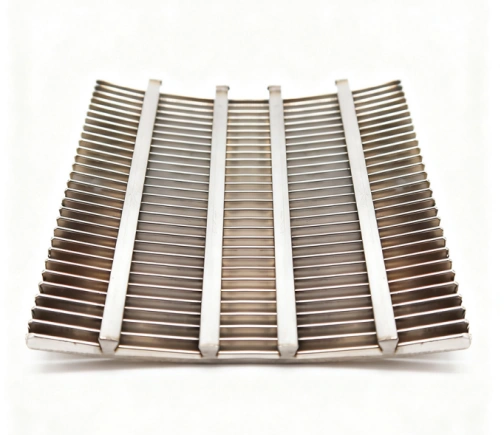
How Does a Wedge Wire Screen Separate Sand?
A wedge wire screen separates by particle size at its surface. The aperture geometry also affects capture, pressure loss, and cleaning.
V-Shaped Surface Wire and Support Rods
Parallel V-shaped wire is resistance-welded to support rods at every intersection. The narrow opening faces the feed and widens below it. Oversize sand stays upstream; smaller particles and liquid pass through. Limited contact with lodged grains supports clog-resistant filtration and backwashing.
Continuous Slots, Open Area, and Hydraulic Performance
A continuous slot creates a long intake edge. More open area can lower entrance velocity, head loss, and abrasive impact. Screen diameter, exposed length, solids loading, viscosity, fittings, and any gravel pack belong in the pressure-drop calculation.
Which Parameters Control Sand Separation Efficiency?
Selection starts with a representative sieve analysis. D10, D50, and D90 describe the particle-size distribution; the retention target then sets the slot.
Slot Size Based on Particle-Size Distribution
The slot opening size retains the specified coarse fraction while the selected fine fraction passes during development or separation. Undersized slots raise differential pressure and cleaning frequency. Oversized slots increase carryover and downstream wear. One local wide slot can dominate sand passage.
Screen Geometry and Available Specifications
The wedge wire screen filter range includes flat, curved, cylindrical, and nozzle forms. Available specifications include:
| Parameter | Available Range or Options | Selection Relevance |
| Slot opening | 0.02-5.00 mm | Match the tested sand distribution and retention target |
| Screen length | Up to 6,000 mm | Adds intake area and affects entrance velocity |
| Screen width | 25-1,200 mm | Sets panel area and equipment fit |
| Surface wire | 1.50-3.70 mm listed sizes | Sets slot geometry and wear section |
| Support profile | 2.20-7.00 mm listed sizes | Carries bending and collapse loads |
| Round support wire | 2.50-6.00 mm | Offers alternate support geometry |
| Materials | 304, 304L, 316, 316L; project-specific Inconel 600, 601, 625, or C-276 after engineering review | Connect corrosion, temperature, strength, welding, and cleaning requirements to the service duty |
Where Do Wedge Wire Screens Handle Sand?
Service loads vary. Well screens face formation pressure; process panels may face vibration, abrasion, or repeated cleaning.
Water Wells and Oil and Gas Sand Control
A water well screen admits groundwater and retains formation sand or a designed gravel pack. In oil and gas service, a sand control screen limits solids that erode valves, pumps, and pipelines. V-shaped wire around longitudinal rods forms a continuous slot screen for radial flow. Candidate materials for project review include 316L and Inconel 625 for sand separation and seawater filtration, plus Inconel 625 or C-276 for corrosive-fluid filtration. Produced-water chemistry, chlorides, H2S and CO2 exposure, temperature, pressure, and welding requirements determine the final grade.
Mining, Tailings, and Water Treatment
Flat and curved panels classify minerals, recover tailings solids, and drain slurry. Cylinders handle granular classification. Water-treatment units use solid-liquid separation for intakes, wastewater, and sand filtration. Related designs serve food, beverage, pulp, and petrochemical processing.
How Should You Specify a Screen for Stable Operation?
The purchase specification should connect process data to measurable features: particle-size curve, retention target, flow, allowable pressure drop, temperature, chemistry, pressure direction, loads, and cleaning method.
Material, Surface Condition, and Fabrication
304 suits many general water duties. 316L stainless steel contains molybdenum and low carbon for chloride exposure and welded assemblies. Duplex grades serve higher loads and chloride stress-corrosion conditions. Surface finish describes texture; pickling removes heat tint and scale, while passivating develops a chromium-rich oxide layer.
Nickel-Alloy Options for Heat and Corrosion
Project alloys cover duties defined by elevated temperature or aggressive fluid chemistry. Inconel 600 and 601 serve high-temperature gas filtration, catalyst service, and heat-treatment equipment. Inconel 625 combines strength with resistance to pitting and crevice corrosion and serves corrosive-liquid filtration, oil and gas, marine, and environmental equipment. C-276 serves strongly corrosive chemical liquids, scrubber equipment, and corrosive waste streams.
Treat these grades as candidates for engineering review. The purchase specification should state fluid composition, chloride concentration, pH, oxidizing or reducing conditions, H2S and CO2 exposure, operating temperature, design pressure, pressure direction, weld procedure, heat treatment, cleaning chemistry, and required material certificates.
Production uses cold drawing, annealing, shaped rolling, another anneal, and fine drawing. Jingzhou Metal verifies alloy composition, dimensions, and tensile properties before screen fabrication.
Cleaning and Inspection
Backwashing reverses flow before differential pressure reaches the operating limit. Exposed panels may use spray or mechanical cleaning. Inspection tracks slot width, welds, deformation, corrosion, and pressure loss. Cleaning chemistry must suit the alloy and solids.
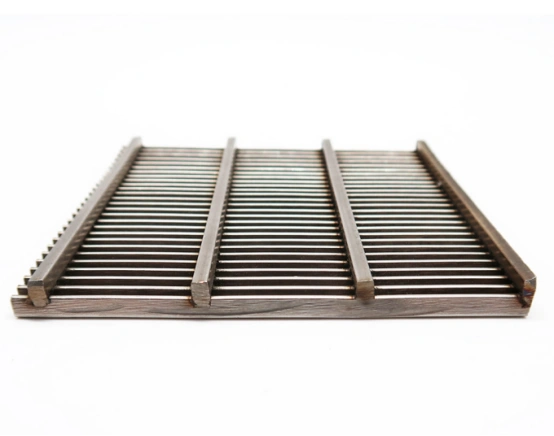
Engineering Support for a Repeatable Screen Specification
Once the hydraulic duty and sand curve are fixed, production control determines whether each screen matches the design.
Profile-Wire Control and Verification
Jingzhou Metal develops the V-shaped wire used in screen production. Its range covers 0.5 × 1.0 mm to 5.0 × 10.0 mm profiles with a listed dimensional tolerance of ±0.01 mm. Infrared monitoring checks coil runout; projection inspection, tensile testing, and alloy analysis verify material before assembly.
Custom Geometry for the Separation Duty
Custom geometry can follow particle data and load. CAD-based development and a listed 7-15-day R&D cycle support sampling. Approval points include material grade, profile dimensions, slot map, weld integrity, and finished geometry.
FAQ
Q1: What sand data should accompany a screen inquiry?
A: Provide D10, D50, D90, solids concentration, particle shape, density, and the required retained fraction.
Q2: Can one slot size cover a broad sand distribution?
A: A broad distribution may need staged screening, a gravel pack, or a test section. Pilot data can set carryover and pressure-loss limits.
Q3: How is slot accuracy verified on a finished screen?
A: An inspection plan maps slot width at defined axial and circumferential positions, then records minimum, maximum, and average values.
Q4: When is 316L preferred for a sand control screen?
A: 316L commonly serves welded screens exposed to chlorides. Chemistry, temperature, and pressure govern final selection.
Q5: Which documents help qualify a screen order?
A: Request a material certificate, dimensional report, slot record, weld criteria, profile-wire tensile data, and traceable packing identification.
Q6: When should a nickel-based alloy be considered?
A: Specify the duty first. Inconel 600 and 601 fit high-temperature gas and catalyst service. Inconel 625 fits sand separation, seawater, oil and gas, and corrosive-fluid filtration. C-276 fits strongly corrosive chemical and waste streams. Confirm the grade against chemistry, temperature, pressure, welding, heat treatment, and cleaning data before order release.