


A purchase drawing may change a slot by only 0.2 mm. Across thousands of openings, that change alters retention, hydraulic capacity, pressure drop, and cleaning frequency. Industrial buyers specify customized slot sizes around the feed particle-size distribution and operating load.
Jingzhou Metal supplies profile wire and screen components for industrial filtration in water treatment, oil and gas, mining, beverages, powder screening, and pulp processing.
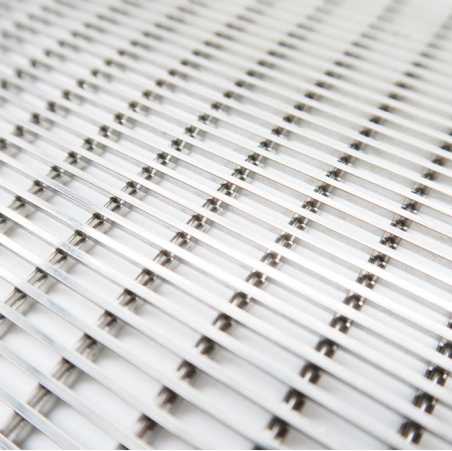
How Do Customized Slot Sizes Control Process Results?
The wedge wire screen slot size defines the narrowest opening between adjacent surface wires. Your target cut size, particle shape, solids concentration, viscosity, and flow rate set the practical starting point. A trial with representative feed then confirms retention and throughput.
Retention, Flow, and Blinding
A small slot retains finer particles and raises flow resistance. A larger slot passes more liquid and may release saleable solids. Fibrous or compressible matter can bridge an opening that appears adequate from sieve data alone. The V-shaped profile wire creates an aperture that widens below the screening surface, which limits particle contact and helps release lodged solids.
Geometric open area for parallel wires is approximately slot / (slot + surface-wire width) x 100. With a 1.50 mm surface wire, a 0.50 mm slot gives 25%; a 1.00 mm slot gives 40%, before support and frame blockage. This calculation supports hydraulic comparison before testing.
How Is a Wedge Wire Screen Built?
A manufacturer resistance-welds parallel surface wires to support rods at every intersection. The assembly forms a rigid continuous slot along the screen face. Support size and spacing govern deflection; the surface-wire nose and slot tolerance govern separation.
Screen Forms and Flow Direction
Flat panels serve static decks and heavy-duty screening. Curved panels suit gravity-fed slurry classification. Cylinders, baskets, tubes, and nozzles handle continuous solid-liquid separation; cylindrical baskets can accept outside-to-inside or inside-to-outside flow.
Stainless steel wedge wire screen options include SS304, SS304L, SS316, and SS316L, with SS321, duplex grades, and nickel alloys available for specific media.
Where Do Slot-Specific Screens Work?
Each process presents different particle geometry and fouling behavior. Use these starting ranges with feed testing, allowable solids loss, pressure, and cleaning method.
Typical Application Ranges
| Application | Typical Slot Range | Main Design Concern |
| Sugar juice screening | 0.50-1.20 mm | Fibers, viscosity, product recovery |
| Starch fiber separation | 0.30-0.70 mm | Sticky slurry and blinding |
| Mineral dewatering | 0.20-1.00 mm | Abrasion, impact, solids loading |
| Pulp and paper filtration | 0.15-0.60 mm | Fiber recovery and cleaning |
| Wastewater screening | 0.25-1.50 mm | Variable solids, pH, flow peaks |
What Should Your Purchase Specification Cover?
A usable inquiry links the slot to the screen system. Include particle-size distribution, cut point, solids rate, liquid flow, temperature, pH, chlorides, differential pressure, cleaning cycle, flow direction, dimensions, mounting details, and permitted pressure drop.
Parameter Window and Acceptance Checks
| Parameter | Available Reference Range | Purchase Check |
| Slot opening | 0.02-5.00 mm | State nominal slot, slot tolerance, and inspection method |
| Screen width and length | 25-1,200 mm wide; up to 6,000 mm long | Confirm flatness and mounting allowance |
| Surface-wire options | 1.50, 1.80, 2.30, 3.00, 3.30, 3.70 mm | Confirm profile drawing and nose radius |
| Support-rod options | 2.30, 3.00, 3.30, 3.70 mm | Verify spacing against pressure and vibration |
| Support-wire range | 2.70-6.30 mm height; 2.50-6.00 mm round | Check load direction and weld layout |
Profile-wire dimensional tolerance and finished-screen slot tolerance require separate acceptance values. A raw V-wire specification may carry +/-0.01 mm dimensional tolerance. The screen drawing should define slot limits, sampling frequency, weld integrity, and flatness. Surface roughness uses an Ra value; polishing and pickling describe treatment processes.
Building Slot Accuracy into the Supply Route
Stable slots begin with repeatable profile geometry. Wire production data helps buyers assess a wedge wire screen manufacturer.
Profile Control before Screen Fabrication
Jingzhou Metal develops profile tooling from drawings and reports a 7-15 day new-product development cycle. Its route covers wire drawing, annealing, shaped rolling, and second annealing. Infrared monitoring checks variation along the coil; 1D and 2D projectors verify profile dimensions. Buyers can align this wire record with the finished slot map, material certificate, and weld inspection criteria.
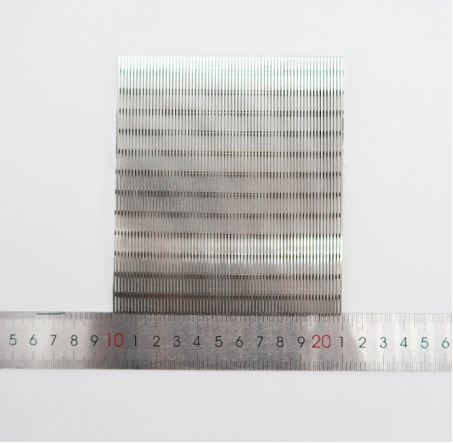
FAQ
Q1: Can one screen use more than one slot size?
A: Yes. Zoned slots can match changing feed conditions along a curved screen or dewatering deck. The drawing should define each zone and transition.
Q2: How should slot tolerance be inspected?
A: Agree on calibrated gauges or optical measurement, sampling locations, sample count, and acceptance limits. A slot map provides stronger evidence than one average value.
Q3: Does a finer slot always produce drier solids?
A: Feed permeability, bed depth, open area, pressure, and drainage time also control moisture. Pilot data gives the reliable answer.
Q4: Which grade suits chloride service?
A: Chloride level, temperature, pH, and stress determine the grade. SS316L may suit moderate exposure; duplex or higher alloys may fit severe service after corrosion review.
Q5: What data supports a replacement screen order?
A: Record the current slot, profile, support spacing, dimensions, flow direction, service hours, failure location, throughput, and retained-solids result. These details help the supplier correct the failure mechanism in the new design.