


Industrial filtration components perform reliably when the alloy, slot, weld design and surface condition match the process. Your selection should begin with chemistry and duty cycle, then move to geometry, fabrication and inspection records.
Why Does Material Choice Set Filter Service Life?
Material choice affects corrosion resistance, mechanical strength and cleaning life. A stainless steel filter screen suitable for neutral water may pit in chloride brine or lose performance after repeated caustic cleaning.
Corrosion and Chemical Compatibility
304/304L works for many general water and dry-powder applications. 316/316L contains molybdenum and offers stronger chloride resistance, making it common in seawater, process liquor and beverage systems. Higher-alloy stainless steels or nickel alloys may be required for severe acids, reducing chemicals or elevated temperatures.
Confirm concentration, temperature and exposure time. Alloy selection without process data remains incomplete.
Temperature, Pressure and Mechanical Load
Review continuous temperature, peak temperature, thermal cycling and differential pressure. Thermal expansion can distort long panels. Slurry loading can bend unsupported spans. Support rods, rings and frame thickness must carry the pressure load.
| Duty Parameter | Design Question | Selection Effect |
| Temperature | Continuous and peak value? | Alloy strength and expansion |
| Differential pressure | Clean and blocked pressure? | Rod pitch, support rings and weld size |
| Chemistry | Chloride, acid or caustic level? | 304L, 316L or higher alloy |
| Cleaning | Backwash, CIP or chemical wash? | Open area, finish and weld access |
How Are Wedge-Wire Filter Components Built?
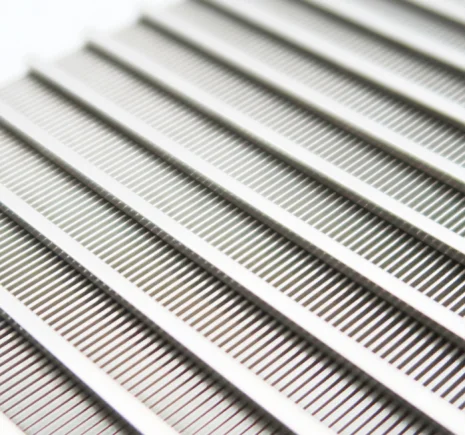
A wedge-wire component uses profile wires welded to support rods. The continuous slot allows liquid or gas to pass while retaining solids on the upstream face. This structure provides predictable openings and good resistance to blinding when the slot orientation suits the flow.
Profile Wire, Support Rods and Weld Joints
Triangular profile wire creates a narrow particle contact line. Support rods may run longitudinally or circumferentially in panels, cylinders and baskets. Weld penetration, spacing and frame attachment determine whether the screen maintains its slot under load.
Slot Opening, Open Area and Retention
Specify the wedge wire slot opening in micrometres or millimetres. A smaller slot retains finer particles but reduces filter open area and increases pressure drop. Drawings should state slot tolerance, wire width, rod pitch, panel dimensions and target open area. See the wedge wire screen filter range for typical component configurations.
Surface Finish Versus Surface Treatment
Surface finish describes measured texture, commonly reported as Ra. Surface treatment changes the surface chemically or physically. Pickling removes oxides and heat tint. Passivation rebuilds the chromium-rich passive film. Electropolishing lowers surface peaks and improves cleanability. Coating adds a separate layer.
These terms should remain separate in hygienic and high-purity specifications.
Which Industrial Processes Use These Components?
The same basic structure serves different equipment because slot size, alloy, support and finish change with the medium and contaminant.
Water, Oil and Gas, and Mining
A water treatment screen separates grit, fiber and biological solids in intake, well and rotary-drum equipment. An oil and gas sand control screen must tolerate erosion and pressure cycling. A mining dewatering screen handles abrasive slurry, so support strength and wear allowance may matter more than an extremely fine slot.
Food, Beverage, Powder and Pulp
A hygienic beverage filter needs crevice-free welds and a cleanable surface for repeated CIP cycles. A powder screening filter relies on slot consistency and open area for classification throughput. Pulp and paper screens must pass fiber-laden flow without rapid blinding.
What Quality Data Should You Request?
Request material certificates, dimensional reports, weld details and inspection limits. A visually polished sample cannot represent an entire production batch.
In-Process Checks and Final Inspection
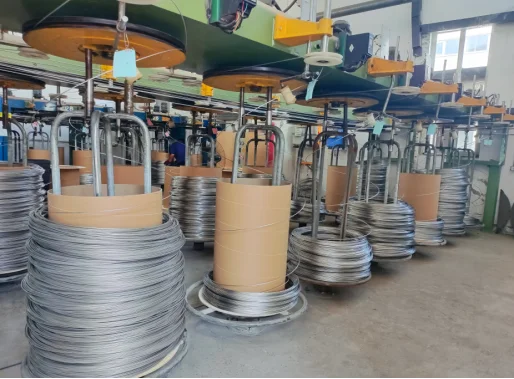
Stainless steel wire quality control starts with diameter, surface-defect, scale and coil-weight checks. Operators verify die threading and wire direction. They cut 80–100 cm samples, place them on a flat surface and check straightness against a square. The recorded angle must not exceed 30°.
After winding, production uses a defined tension setting of 150. Operators check appearance every hour for damage, deformation, discoloration, edge defects and missing wire. Finished dimensions also receive hourly checks. Slot gauge inspection confirms opening consistency before packaging.
Practical Specification Table
| Specification Item | Example Requirement | Purpose |
| Alloy | 316L with heat number | Corrosion resistance and traceability |
| Slot opening | 0.20–1.00 mm nominal | Retention and pressure drop |
| Profile wire | Triangular, width and height stated | Flow path and strength |
| Support rod | Diameter and pitch stated | Differential-pressure capacity |
| Straightness | 80–100 cm sample, angle ≤30° | Assembly fit |
| Surface condition | Ra plus treatment process | Cleanability and corrosion behavior |
| Inspection frequency | Appearance and size hourly | Early detection of variation |
Matching Material and Geometry to Your Duty Cycle
Start with contaminant size and solids loading. Then verify chemistry, temperature, pressure and cleaning method. Select the coarsest slot that meets retention; it normally provides more open area and lower pump energy.
For hygienic service, specify Ra and treatment separately. When blockage pressure may rise quickly, reduce unsupported span or add support rings.
Where Material Control Becomes a Design Advantage
Jingzhou Metal supplies wedge-wire screens, mesh and formed stainless steel wire parts for water treatment, oil and gas, mining, powder, beverage and pulp applications. Its technical value lies in linking material control with finished geometry.
Incoming-wire checks, die-direction verification, straightness records, the 150 tension setting and hourly appearance and dimensional inspections create traceable production data. That record helps you repeat a proven slot, rod pitch or frame design with fewer surprises. Additional product information is available through Jingzhou Metal.
FAQ
Q1: Which stainless steel is a practical starting point for industrial filtration components?
A: 304L suits many general duties. 316L is usually preferable for chloride-bearing water, process liquor and repeated caustic cleaning.
Q2: How does wedge wire slot opening affect pump energy?
A: Smaller openings improve particle retention but reduce open area and increase pressure drop. Fouling allowance should be included in the design.
Q3: Is electropolishing required for every hygienic beverage filter?
A: No. Define the required Ra, weld profile and cleaning regime first. Pickling and passivation may be sufficient.
Q4: What data confirms that a stainless steel filter screen will keep its shape?
A: Request wire and rod dimensions, weld details, pressure calculations, straightness results and dimensional inspection records.
Q5: Can one screen design serve both water treatment and mining?
A: The wedge-wire principle can serve both, but slot size, rod pitch, frame support, alloy and wear allowance should reflect the specific duty.